
The Normalization of Stress in Youth
“I got seven hours of sleep last night.”
“Seven? Imagine. I got six.”
“Couldn’t be me. I got four.”
“Wait…Y’all slept last night?”
Last week, I happened to overhear this conversation in the hallway. A couple of kids were standing beside the lockers talking about their lack of sleep. It seemed like a casual conversation, except it’s also a warning. Stress is standard for students—except it shouldn’t be. It’s become so normal that student burnout is a flex. If you’re scared, anxious, stressed, overwhelmed, or anything else, don’t worry! It’s just a part of growing up! Throwing a mask over your pain is exactly what you need to do. Obviously, you should lie to everyone you meet and tell them you’re okay, even if you’re not. So go ahead, smile, nod, say “I’m fine,” and slowly fall apart when no one can see you. That’s normal. That’s what we, as a society, have deemed acceptable.
If that sounds messed up to you…good. It should. Stress, anxiety, depression, it’s all become so normalized now that often people don’t even notice it.
In this day and age, people expect children to be stressed. They think that stress encourages them to do better. People act like the busier you are, the more you have going on in your life, the better you are. Pushing through exhaustion, sacrificing sleep, and having a packed schedule shows dedication and worth instead of burnout and being overworked.
It’s because of this it’s hard to realize when stress becomes toxic and out of control. Unfortunately, it’s increasingly common that no one sees when stress turns into something so much heavier. Parents think that when they push their child, it’s helping them, but they don’t always consider the impacts it could have on their mental health. Yes, everyone wants their child to succeed. People keep piling pressure onto kids, and they just don’t know when to stop. The expectations disguised as motivation are eating away at kids and their mental health, and people think that’s normal. But is it normal? Is it normal to wake up every day and use every single ounce of your strength to just get out of bed? Is it normal to be so anxious that your heart is racing before the day has even begun? Is it normal to sit in a classroom, surrounded by people, and still feel completely alone? No. It’s not. But for so many kids, it is. That’s the problem.
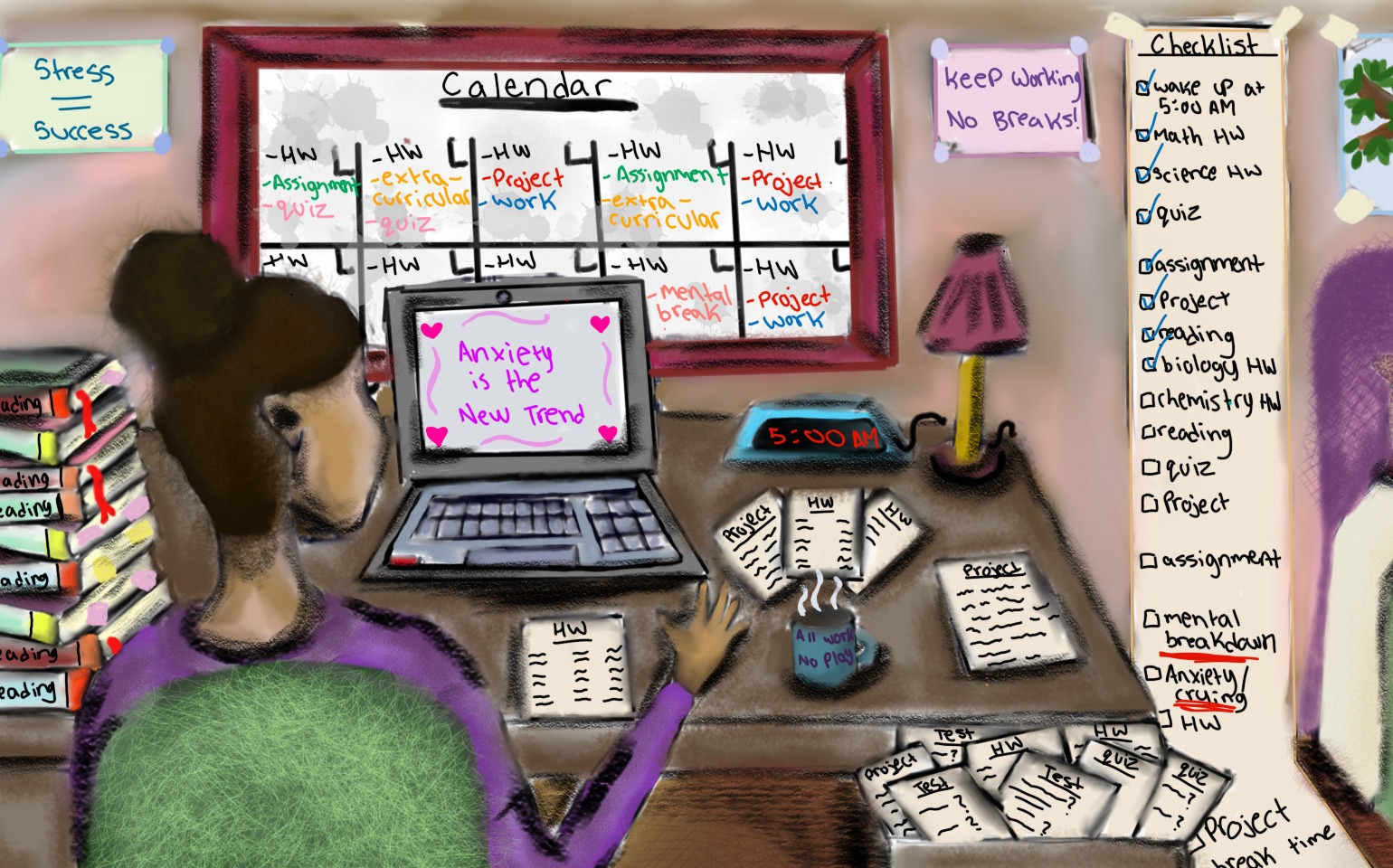
Stress has become glorified and anxiety has been made aesthetic. Pastel posters turn panic attacks into relatable, trendy cartoons.
Mental health diagnoses have become something to brag about—some people even put it in their social media bios. Clothing brands will sell sweaters with slogans like, “I don’t struggle with anxiety. I’ve actually become pretty good at it.”
The other day, I was scrolling on YouTube and came across a short of a song. The lyrics were all about pretending to be fine, and the comments were full of people saying, “Wow, that’s so relatable,” “This is me every day,” “I totally get this.” It wasn’t the song they connected to. It was the exhaustion behind it. Everyone treated it like a shared inside joke, as if breaking down quietly is just another part of the daily routine. The fact that so many people saw themselves in that pain says everything about the world we’ve built.
Both academic and social culture play a huge role in how stress is now a necessity instead of a problem. Overworking yourself and being overwhelmed are now signs that you are successful. Kids are expected to somehow manage school, life, and a ton of extracurriculars. The pressure to get into university not only relies on marks, but on a multitude of clubs and initiatives. Even in middle school, the stress and expectations that children face is overwhelming. Assignments, tests, projects, just keep building up on kids, like placing bricks in their backpack and expecting them to keep carrying it.
Think about this. Teens are at school for about six and a half hours. Add in the commute, and that’s seven hours gone. They also need approximately nine hours of sleep. Then dedicate an hour to eating. Now add another three hours for homework, and two for studying. We also can’t forget about the million extracurriculars kids need, so dedicate two hours to that. How many hours does that add up to? A full day. Completely accounted for. No free time. No rest. No space to breathe. Just a perfectly packed schedule that somehow still expects more. If kids try to say something, by telling their teachers or parents they’re overwhelmed, the response is typically, “Manage your time better.” But maybe the issue was never time, it’s what we’re trying to fit inside it. Students are treated like machines. Machines without lives and feelings and anxiety.
Stress is built into our society. It is the default setting in life. It is the basic requirement to be successful. Anxiety shouldn’t be expected. Depression shouldn’t be a trend. Stress shouldn’t be normal. But it is. In teens, youth, students, it is normal. We don’t call it suffering anymore. We call it life.
Maybe the solution isn’t some revolutionary new program or a magical cure for stress. Maybe it starts with admitting that this isn’t normal. Being exhausted all the time shouldn’t be a personality trait. Having anxiety shouldn’t be a requirement for students. Kids shouldn’t have to earn rest by working themselves into the ground first.
We need to stop treating burnout like an accomplishment and start seeing it for what it is: a warning sign that something isn’t working. Parents, teachers, and students all need to stop asking, “How much can you handle?” and start asking, “How are you doing?” Maybe if we stopped glorifying stress, people wouldn’t feel the need to hide how much they’re struggling. Maybe if we stopped treating suffering like a competition, kids wouldn’t feel so alone. Change won’t happen overnight. But the first step is simple. Stop accepting stress as the price of being successful. Stop calling it normal.

Saia Manchanda
Saia is a student, author, and poet who writes about mental health, teenage life, and the quiet chaos of how society works. Alongside writing, she finds inspiration in music and everyday moments that most people overlook. Her goal isn’t just to write, it’s to leave something behind that makes someone, somewhere, feel less alone.
You may also like

The Power of Self-Improvement: Why Forgiving Yourself Is the First Step
Nathaniel Gelardino takes a look at the art of forgiving yourself and how that can lead to self-impr

Indian Horse: Why Indigenous Authors Matter
Salina Guo takes a look at Richard Wagamese's Indian Horse, and how the novel tackles the oppression
The Power of Perseverance
Sloane Bradley takes a look at perseverance and how pushing through can bring many positives into yo