
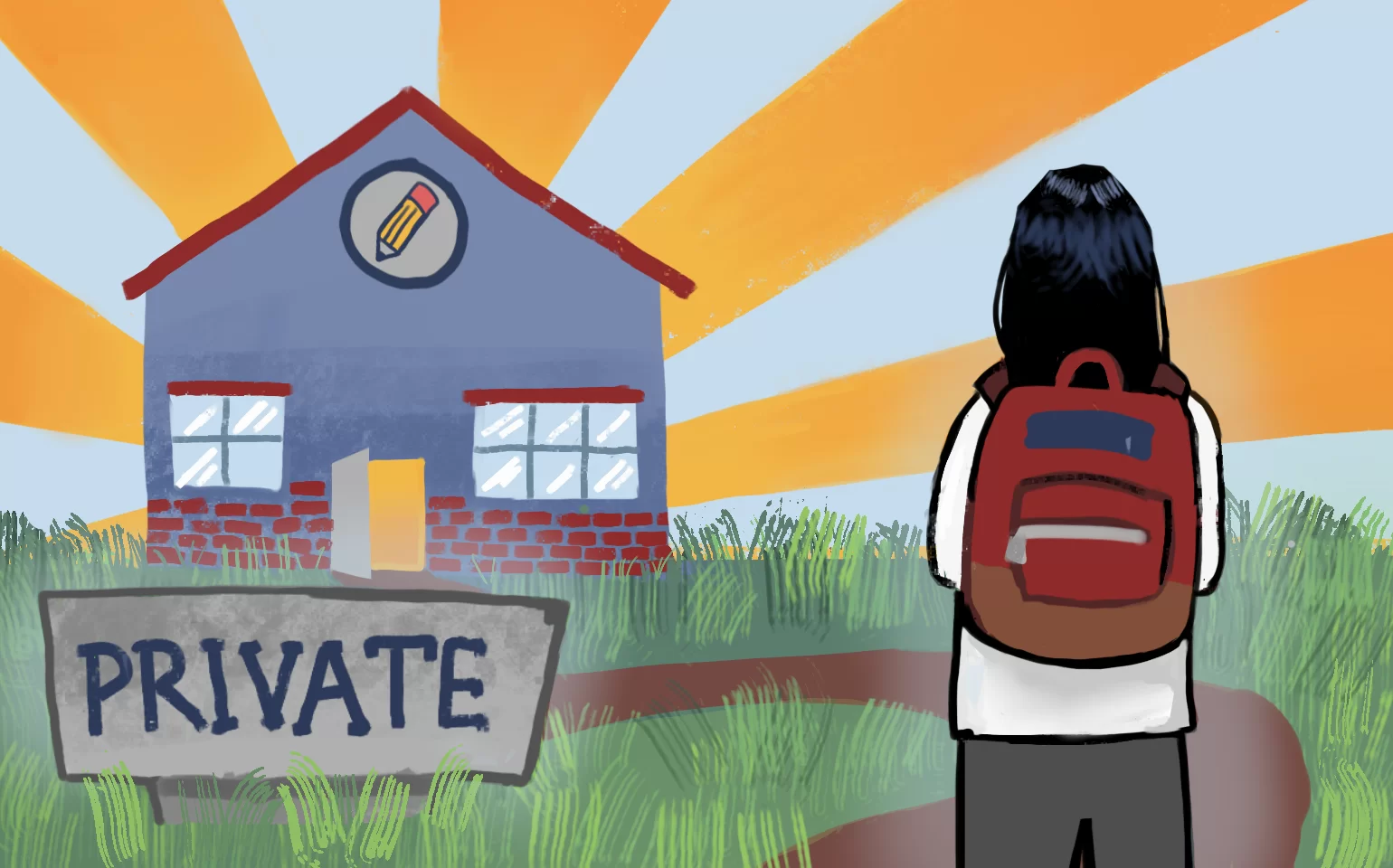
When Everyone Knows Your Name: How Attending a Small Private School Shaped Who I Am
School, whether you like it or not, is an essential part of our childhood, adolescence, and early adulthood. It is a place where we spend countless hours of our time: where connections are made, concepts are learned, and challenges are conquered. The education that you receive not only impacts your academic ability but also plays a key role in your development as a person.
After moving to Canada, my parents enrolled me in a private school with around 200 students, which I attended from preschool all the way to grade four. Starting in grade five, I went to a (somehow) smaller school that only had nine students in its first year of operation! Presently, I am still attending this school, although it has now expanded to have around 80 students, which is still only about 10% of the average high school student body! Attending a small private school has offered me a unique experience that others may not have. It has come with benefits and limitations, both with a significant impact on my identity.
“What school do you go to?” was one of my most dreaded questions of all time. What seemed like a perfectly ordinary question to most became a source of discomfort, alienation, and even shame for me. I remember countless instances where I would answer this question by merely saying “I go to a private school” or “I go to a new school”. If you haven’t picked up on it yet, the strategy here is to never, ever, say the name of the school.
My identity as a private school student made me feel excluded from others my age, and I constantly feared that others would judge or stereotype me because of it.
Now, don’t get me wrong, I love going to my school and am happy with my experience there. However, it doesn’t remove the feelings of self-consciousness and the need to prove the legitimacy of my education and myself to others. I was worried that many people held prejudices against private school students, thinking that they wore a perfectly ironed uniform, attended a fancy British-looking campus (It’s true! Try searching “private school” on the Internet, and you’ll see), and were snobby and entitled. I was afraid that people would use their personal image of my schooling experience to define me without taking the time to get to know who I truly am.At the end of the day, it doesn’t matter if the school you go to is public or private, big or small, because we are all just normal kids trying to achieve our goals.
Attending a small private school has made me more academically focused and capable, due to the class sizes and the education system. Because of my school’s small size, there is a lower student-to-teacher ratio. Each class has around 15 students, which means everyone can receive the support they need, and learning experiences can be personalized to what each person needs to succeed. Furthermore, from what I have heard from others, private schools tend to be more academically demanding than public schools. The schoolwork that I do requires me to not only memorize concepts, but to make connections between them and identify their real-world applications. Therefore, I have become more intelligent and diligent in my studies.
Going to a small school has many drawbacks, but the most obvious and impactful one is undoubtedly the lack of opportunities and resources. My experience at school lacks certain elements that public school students consider common. For example, eating in the school cafeteria and going to homecoming. My school only recently started a student council and a small variety of clubs, and high school students were similarly only recently allowed to leave campus during lunch hours. This lack of resources also affects the learning environment. The school building has an extremely limited number of classrooms and learning spaces, and for my grade, we only have access to around five work spaces, which are also shared with other students of different ages.
Furthermore, there is also an overall limited social life. With fewer than 15 people in a class, you are always interacting with the same people, whether you like it or not.
All these factors contribute to the quality of my day-to-day life at school, but more importantly, cause a feeling of FOMO–missing out on an essential part of the teenage experience.
Another significant impact that attending a private school has had on me is making me more “sheltered”. This is due to the fact that I am exposed to a small group of people on a day-to-day basis, who are from a similar demographic. In public schools, it is easier to be exposed to a larger variety of behaviours, trends, and opinions. Not to mention, the sheer number of students in most public schools makes it more likely to be peer-pressured into doing something to appear more “cool” or “popular”. Although this influence may occasionally be positive, I believe that it is more often not. Furthermore, the requirement to wear uniforms may also contribute to limiting the influence of peers, since it restricts expression and the adoption of certain fashion and makeup trends. It seems that the large student body of public schools emphasizes the social aspect of school life. This isn’t to say that these elements do not exist in private schools; they are just less apparent and play a smaller role in the overall school experience. By attending a private school, I have developed a more independent, decisive, and “naïve” identity.
Similarly, by going to a private school, I have become a less outgoing and more introverted person. I have always been naturally shy and reserved, and attending a small school has accentuated that part of me. Although in a private school, it is arguably easier to develop strong connections with all your peers, these connections, at least from my experience, were mainly due to the forced proximity that came with small class sizes. But in a public school context, the large student body removes this interconnectedness and makes it so that you must rely on your own skills and sociability to put yourself out there. Since I did not have to do this, I was unable to develop as strong social skills as those of a public-school student, making me less comfortable interacting with strangers and making new friends. Additionally, schooling can be a common language and source of connection between adolescents, and when that piece is lacking, it creates a feeling of alienation. On the flip side, my aversion to socialization has allowed me to focus on other aspects of my life, such as academics, health, extracurriculars, etc.
The role that private school has played in encouraging my introverted nature is a double-edged sword – on one hand, it weakens my social skills, and on the other, it allows me to put more time and effort into different fields of my life.
A person’s schooling experience plays a large part in the shaping of their identity, especially because it occurs during a critical period of their life – childhood – where they are constantly adapting and evolving. My personal experience as a private school student has come with drawbacks, such as a lack of resources and making me more reserved, but also countless benefits that allowed me to “level up” by fostering independence and academic capability. Therefore, regardless of the education you receive, it will undoubtedly leave a lasting impact on you.

Amanda Xu
Amanda is a first-generation Chinese Canadian immigrant and a current grade 9 student based in New Brunswick. When not studying, she can be found reading, drawing, and hanging out with friends. Amanda is still unsure about what the future has in store for her, but she hopes that through her writing, she can not only find her own identity but also support and uplift others in the process.
You may also like
Working Through Silence
Catherine writes about how she gained confidence and found her voice by overcoming her fear of speak
Finding Motivation to Write
Writer's block befells even the greatest writers. Find out how to beat it with Angela Luo's tips
The Importance of Sport for Youth
Ever since I’ve been able to run and kick a ball, sports have been a huge part of my life. I come