
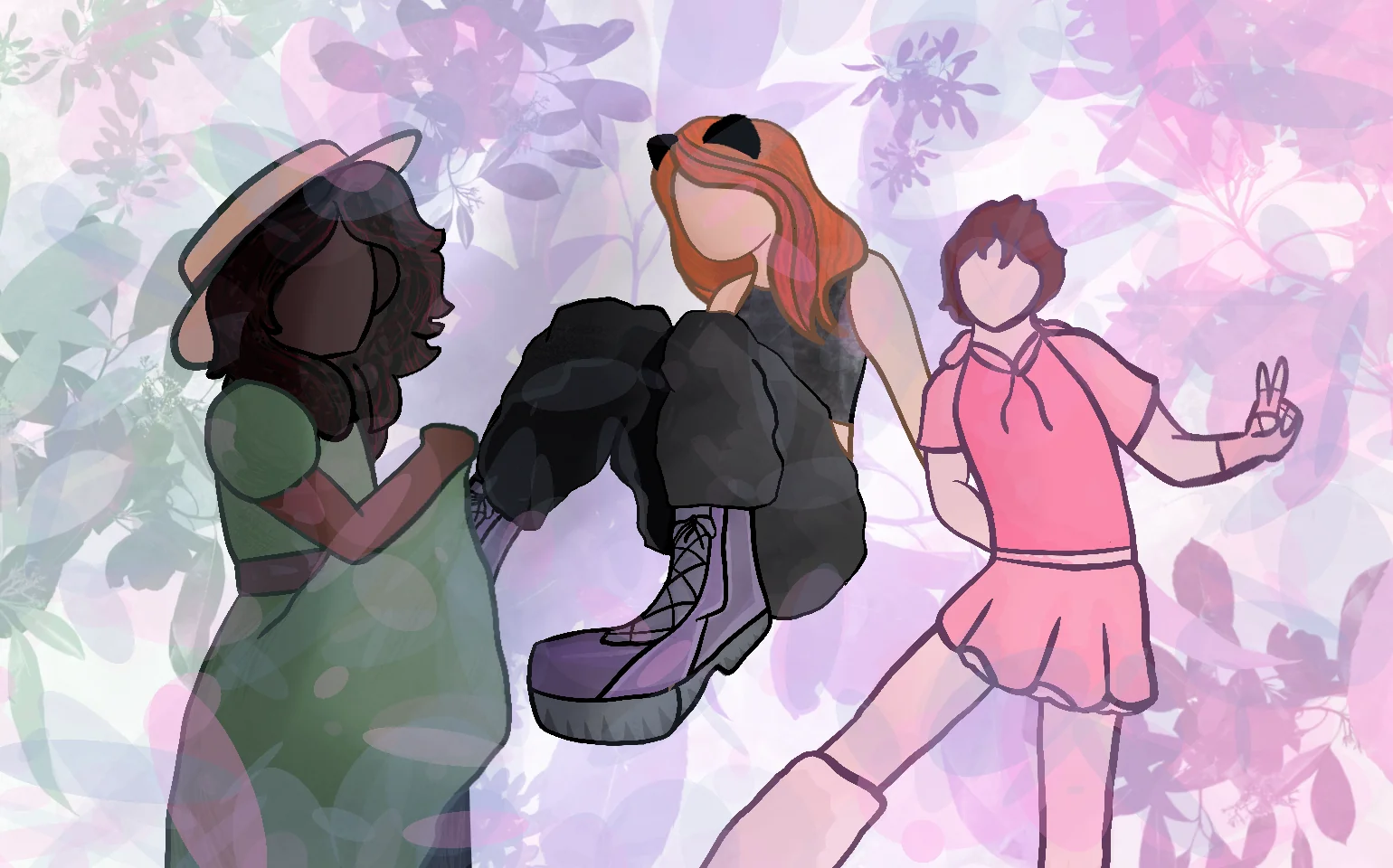
Digital Mirrors: Identity in a Pop-Driven World
Have you ever caught yourself saying a phrase from a viral TikTok, wearing an aesthetic fashion trend or stylistic choice you hated two months ago, or feeling a deep, personal connection to a fictional character’s trauma? Doing any of these doesn’t mean that you’re “basic”; it means that you’re participating in a massive, digital-age identity shift. Being basic, or following the norm, is something that individuals have always tried to deviate from. We feel an innate desire to be special, extraordinary, and one-of-a-kind. An individual may consider themselves basic for following a trend because it is something that a whole group of people have done.
In my own life, I often think of myself as basic for following trends or liking mainstream ideas. I feel unoriginal when I tell my friends I like a viral song, or when I find myself saying viral TikTok phrases. For a long time, I viewed trends as something to avoid so I could appear different. However, I learned that pop culture isn’t just background noise to play while getting ready, but rather a mirror we use to see ourselves, a playground where we test-drive our personalities, and a bridge that connects us to our people.
Pop culture helps us connect with people who share our interests. We can connect with people who like the same books as we do, or have the same music taste. The people we connect with could be anyone, as long as we have something in common with them. For example, I often follow and interact with people who post a lot of book content.
Watching a trending show or movie isn’t only about enjoyment; it’s also shaping your moral compass in subtle ways. The playlists we listen to on repeat and the shows we binge do more than entertain; they teach us about the reality of our world. Pop culture often tackles heavy topics such as mental health, social justice, and complex relationships long before we encounter them in a classroom.
These stories present the realities of the world in ways that feel immediate and personal. Seeing a character struggle with the same anxieties you face can offer a quiet sense of validation, reminding you that you’re not alone in what you feel.
Online platforms like TikTok and Instagram amplify the influence of pop culture even further. Teens can explore different communities, aesthetics, and fan spaces, trying out new looks or interests until they find what feels authentic. While this freedom can be empowering, it also brings pressure to fit in or perform certain personas that align with what gains attention. Recognizing that pressure is essential if pop culture is going to serve as a tool for growth rather than comparison. The key is understanding the difference between inspiration, using a trend to evolve, and imitation, where parts of yourself get lost in the effort to match an algorithm.
Finding something that we relate to is crucial because it fosters a sense of belonging and community. Our personality is a montage of all the different things we enjoy and believe, so finding a community that we connect with can help us develop ourselves. The more an individual explores and interacts with their interest, even if they’re not well-known, the more they accept all the different parts of themselves. However, it is important to remember that our personalities are a mosaic of ourselves, not just one single interest. If we hyper-fixate on only one interest, we begin to lose the other parts that make us who we are.
To avoid losing ourselves to a trend, we often need to take a step back and observe what our hobbies are and if we truly enjoy them. It is crucial to spend time on all of our interests and hobbies, not just one. Instead of hyper-fixating on a trend or a clothing aesthetic, we can spend time looking at other similar trends.
In our world, trends are a form of self-expression that we often overlook as just passing crazes. Think about the latest fashion “core” or that dance challenge as more than a fad, as a tool for self-expression. When you lean into a cottagecore aesthetic or stan a specific K-pop group, you aren’t simply following the crowd; you’re displaying your interests and values to the world.
Trends create a safe space for experimentation, allowing people to try on different versions of themselves to see which one fits best and, in the process, discover who they are becoming.
At the end of the day, pop culture doesn’t define you; you define yourself. Pop culture acts as a space for us to determine what we do and don’t like, and how we perceive the world. It plays a powerful role in shaping identity, especially during the teenage years when self-discovery is at its peak. Trends, music, shows, and online communities help us explore who we are and who we want to become. They can inspire, connect, and encourage experimentation, but your identity ultimately comes from your choices, your beliefs, and the passions you decide to hold onto.

Akshita Nittala
Akshita Nittala is a high school student in Markham, Ontario. Her favorite subjects in school are math and science. In her free time, she enjoys reading, writing and binging shows. Some of her favorite series are Harry Potter, The Hunger Games and The Selection. When she grows up, Akshita wants to be a trauma surgeon.
You may also like
FOMO In Our Lives
Patricia Zhang speaks on her experiences with FOMO and how to cope with its negative effects in the
Being the New Girl
Serena Vivekanand was a new girl in her high school. Here are some of the tips she wishes she knew b
I Am Not My Personality Type
From Freud’s theory of development to Buzzfeed’s countless online quizzes, people have been intr