
Social Media: The Overlooked Obstacle to Love
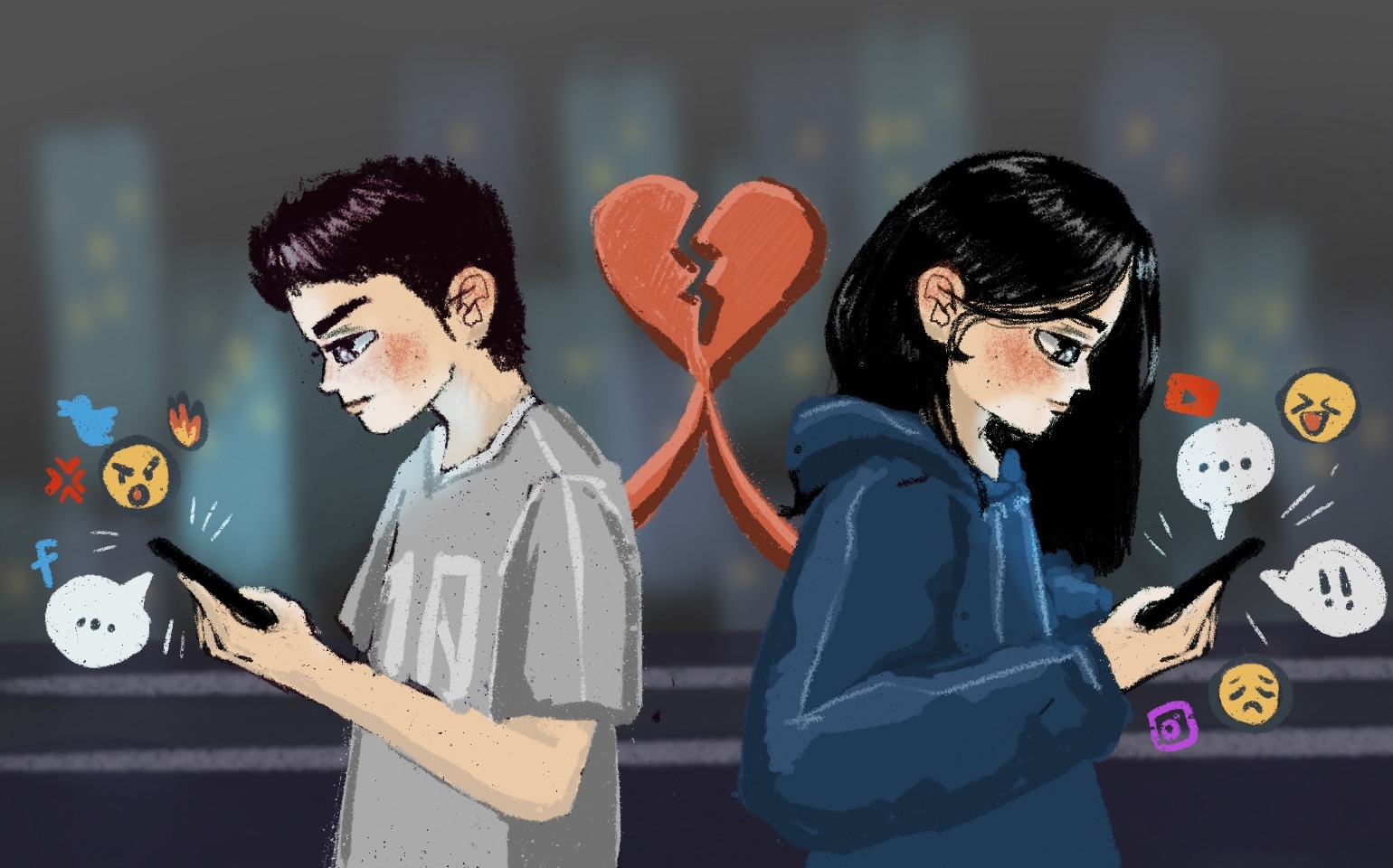
We often believe that love is a magical, warm feeling, one that makes you light up and can conquer all obstacles. However, as we are constantly bombarded with trends that create unrealistic expectations and insecurity in relationships, love becomes more of a performance than a feeling. So why is it that social media has reshaped our perception of love into something more demanding and artificial?
Today, social media is intertwined in our lives; in fact, many of us probably couldn’t imagine our lives without it. Social media provides us with connection, though it also brings its own set of challenges, particularly in relationships.
As you scroll through the dozens of posts on social platforms, jealousy can quickly start to occupy your mind. As everyone posts the best parts of their relationships, whether it be a surprise bouquet of roses or a fancy proposal, it’s easy to feel like your relationship is lacking. But that longing you feel originates from a snapshot of someone’s life that we’ve seen out of context. Such posts work to paint the image of a “perfect relationship.” However, it’s easy to forget this and instead fixate on what we don’t have, ignoring the good in our relationships. These snapshots create unrealistic expectations that can set impossibly high standards.
Posts also highlight over-the-top acts and lavish gifts, leading many to feel discontent with everyday gestures. This contributes to the creation of high standards, many of which your partner cannot reach, leading to dissatisfaction within the relationship.
To add, algorithms rely on strong emotions such as joy, envy, or anger to boost user engagement. Hence, videos that make you feel envious are more likely to show up on your page. Curating the idea that such extravagant gestures are common, despite how they’re not. Plus, it only takes one liked video to have a million more like it pop up. This is troublesome as it can lead to you being sucked into an endless loop of “5 ways to find out if he’s cheating” or “10 signs she’s not interested in you anymore,” feeding your paranoia and causing you to micro analyze your relationship. Even though online users aren’t relationship experts.
Similarly, just as it only takes one like, it also only takes one viral video for something to become normalized in relationships. Social media is becoming a larger and larger influence in our lives; as peer pressure, popular trends, and digital media engulf many of our lives, it is essential we work to think critically about what we consume online. Particularly when participating in trends. Take for example, the viral slogan “If he wanted to, he would.” This slogan circulated throughout the internet, and while it’s meant to be encouraging, it sets the precedent that “he” should be able to read your mind. Spreading the idea that you don’t need to communicate what you want in relationships, foreshadowing disaster. Originally, I didn’t think the phrase was saying anything wrong. But after taking the time to reflect, I realized that love is not a substitute for communication.
Other social media trends also promote quick judgment, painting the world in black and white. An example of such a trend is red and green flags. They oversimplify human behaviour, labelling people for what may have been their worst moments while ignoring factors such as growth and personal needs. Additionally, thanks to social media, these labels have become weapons, as anything labeled a red flag is automatically considered “toxic” with little or no additional consideration. The term “toxic” itself refers to someone or something that is harmful or destructive. Red and green flags often ignore situational context, such as how behaviours can be created by temporary stress rather than a flawed personality trait. Ultimately, red and green flags can cause harsh conclusions to be formed from incomplete snapshots.
Personally, I know that social media is frequently overbearing. And it’s easy to feel “stuck” with what you have. Time and time again, I’ve caught myself comparing my life to other people’s posts despite knowing a single post does not paint an accurate picture. Social media has also changed the way I perceive things and people. Due to social media normalizing certain ideas whilst exiling others. This normalization can change our expectations, often making us demand more. However, it’s important to remember that simply seeing something should not make you deem it to be consistently true.
So, what’s the overall message? Well, it’s to understand how expectations that social media has created are not necessarily right, and rather that you need to consider what you need. Remember: a single post never tells the full story. Next time you’re scrolling, think critically. Would you want someone to expect that of you? Is it really something that can be generalized? And what adverse effects may it have? By asking yourself these questions, you’ll be sure to do what’s good for you and your relationship rather than what the internet promotes.

Vrishika Mehta
Vrishika is a driven student who is always looking to try new things! She has a huge sweet tooth and an endless list of shows to watch. An aspiring neuropsychologist, you can always find her curled up with a book or chatting away about some random topic to anyone who will listen!
You may also like
Social Media and Attitudes Towards Women
Clair Yu investigates the attitudes (both positive and negative) surrounding women on social media,
An Idol’s Influence
Ally Yang takes a look at what types of influence an idol can have over the idolizer, and how that i
A Sister, a Brother, and an Origami Crane
A sister learns a valuable lesson in never taking her life or her family's lives for granted when